Marriage
Choosing who to marry. Accepting or saying no to a proposal.

Complete Istikhara guide in Arabic, English & Transliteration
✓ Authentic Hadith Source ✓ Step-by-Step Guide ✓ Marriage & Career Guidance
📖 Reading Time: ~20 minutes | Last Updated: March 01, 2026
Quick navigation to all sections
Watch complete tutorial
Understanding the prayer
Spiritual significance explained
Arabic, transliteration & translation
Free printable Istikhara guide
7 easy steps guide
Is my matter suitable for Istikhara?
Best times & understanding results
Special guidance for life partners
Spiritual & practical advantages
Recognizing divine guidance
Education, career & personal life
Best practices & manners
Complete practical guide
Frequently asked questions
Get personalized guidance
🌐 Online Istikhara Service
Can't do it yourself? Let a certified scholar perform it for you — privately & worldwide.
Watch our comprehensive video guide on Istikhara with proper pronunciation
📞 Contact Mufti Hasan: +44 7503 696292 | 💬 WhatsApp
Istikhara (استخارة) is a special Islamic prayer. You pray it when you need Allah's help with big decisions.
The word comes from Arabic. It means "asking for what is best."
How it works:
You pray 2 rak'ah. Then you make a special dua. You ask Allah to guide you to the right choice.
The Prophet Muhammad ﷺ taught us this prayer. It helps with both this life and the next.
When to use Istikhara:
Choosing who to marry. Accepting or saying no to a proposal.
Changing jobs. Starting a business. Picking a course.
Buying property. Big investments. Important financial choices.
Moving to a new city. Going abroad. Big family decisions.
Only use Istikhara for halal (allowed) things. Don't use it for haram (forbidden) matters.
What Does Istikhara Mean?
The word "Istikhara" (استخارة) comes from Arabic root letters خ-ي-ر (Kha-Ya-Ra), which means "to seek goodness" or "to ask for what is best." When you perform Istikhara, you're literally asking Allah to choose the best option for you.
Isti-khara = To seek (isti) + goodness (khara)
Full Meaning: "Seeking Allah's guidance to choose what is best and most beneficial"
خ-ي-ر (Kha-Ya-Ra) - The root word means "good," "better," or "best." Same root as "Khair" (goodness).
"Istikharah" uses the Form X pattern (استفعال) which means "to seek" or "to ask for" something.
Seeking Allah's help in choosing what He knows is best for you in matters where the right choice is unclear.
Acknowledging that only Allah knows what's truly best for your worldly life and hereafter.
A Sunnah prayer taught by Prophet Muhammad ﷺ to seek Allah's divine wisdom when making important decisions.
Demonstrates complete trust in Allah's knowledge and power while taking action in your life.
A beautiful gift from Allah allowing believers to consult Him directly for guidance in permissible matters.
Combines human effort (making a choice) with divine guidance (asking Allah to facilitate what's best).
"Prayer for seeking Allah's guidance" or "Seeking the best choice through prayer to Allah"
خیر طلب کرنا - "Khair talab karna" - Seeking goodness and Allah's choice in a matter
भलाई की तलाश - "Bhalayi ki talaash" - Seeking Allah's guidance for what is best
কল্যাণ অন্বেষণ - "Kollayan onneshan" - Prayer to seek Allah's choice in matters of uncertainty
Jabir ibn Abdullah (RA) reported: "The Messenger of Allah ﷺ used to teach us to seek Allah's choice (Istikhara) in all matters, just as he used to teach us the Surahs of the Quran."
Source: Sahih al-Bukhari 1162
Istikhara is NOT fortune-telling. It means surrendering your decision to Allah's wisdom, asking Him to make easy what is good and to turn you away from what is harmful.
In Arabic:
Dua for Istikhara - Transliteration:
Dua for Istikhara in English Translation:
Save or share this step-by-step visual guide
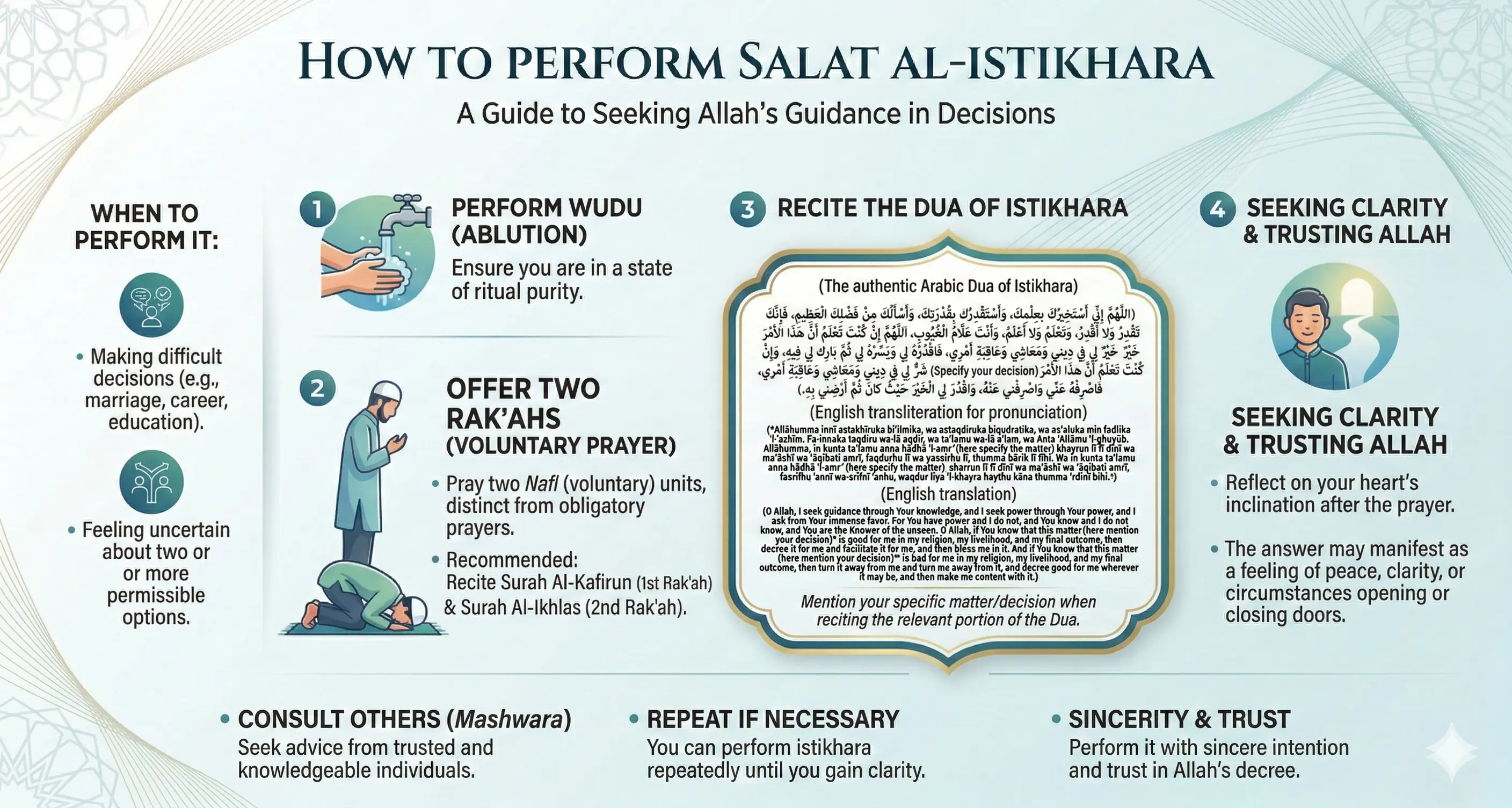
📌 Screenshot or save this infographic for easy reference
⬇️ Download InfographicFree printable guide — Arabic, Transliteration & English in one beautiful document
Follow these steps. This is how the Prophet ﷺ taught it.
Wash for prayer. Wear clean clothes. Face the Qiblah.
Pray two units. Read any surah after Al-Fatiha. This is a nafl (extra) prayer.
Do tashahhud. Send blessings on the Prophet. Say salam.
After salam, raise your hands. Get ready for the special dua.
Say the full Istikhara dua. When you reach "this matter," say what you need help with.
Ask Allah to make it easy if it's good. Ask Him to turn you away if it's not.
You can pray again for 2-7 nights. Stop when you feel clear about your choice.
Last third of the night is best. Or pray between Maghrib and Isha. Don't pray at the 3 forbidden times.
Answer these questions honestly. The checker will guide you based on authentic Islamic principles.
Select the category that best describes your situation.
You can perform Istikhara multiple times for the same matter until you feel confident about your decision. Some scholars recommend praying it for seven consecutive days.
You may feel a sense of peace and inclination toward a particular choice.
Allah may make one option easier and remove obstacles from your path.
While not necessary, some people may receive guidance through dreams.
Continue seeking advice from knowledgeable, trustworthy people alongside your Istikhara.
Marriage is one of the most significant decisions in life, making Istikhara particularly important in this context.
Mention the person's name or characteristics you're considering for marriage.
Think about religious compatibility, character, family background, and practical considerations.
Encourage your family members to also perform Istikhara and seek their counsel.
Have faith that Allah will guide you to what's best for your spiritual and worldly life.
When you reach "hadha al-amr" in the dua, say: "marriage with [person's name]" or "accepting this marriage proposal."
Constant reliance on Allah's guidance deepens your trust and connection with the Creator.
Surrendering decisions to Allah's wisdom provides peace of mind and reduces stress.
Waiting for Allah's guidance teaches patience and helps avoid hasty decisions.
Decisions made through Istikhara often lead to blessed outcomes and divine favor.
Regular practice strengthens your reliance on Allah while taking practical steps.
A deep sense of tranquility and confidence about a particular choice.
Feeling drawn toward one option without force or pressure.
Continued discomfort or anxiety about a particular choice despite practical advantages.
Sudden understanding or insight about the right path forward.
Unexpected opportunities or removal of obstacles making one path easier.
Difficulties that consistently prevent you from pursuing a particular option.
Meeting helpful, righteous people who facilitate your preferred choice.
Events aligning in a way that makes one choice clearly more appropriate.
Allah's choice for you is always best, even if it differs from your initial preference. Trust in His wisdom and timing.
Consider Islamic environment, career prospects, financial cost, and family distance.
Pray for guidance toward careers that benefit both your worldly life and akhirah.
Seek guidance about maintaining Islamic values in different environments.
Consider halal income, work-life balance, and spiritual growth opportunities.
Ensure the business model is halal and will benefit the community.
Seek guidance about business partners and potential for ethical collaboration.
Consider Islamic community, children's education, and opportunities for da'wah.
Seek guidance on timing while trusting in Allah's decree regarding provision.
Consider financial stability, community environment, and long-term family needs.
Last third of the night, between Maghrib and Isha, after obligatory prayers, or on Friday.
Perform complete ghusl if possible, ensure wudu is fresh, wear clean clothing.
Clear your mind of distractions, set sincere intentions, focus on seeking Allah's guidance.
Choose a quiet space, turn off devices, create an atmosphere conducive to prayer.
A concise, authentic and practical guide to Salatul Istikhara—learn the exact dua, step-by-step method, signs of response, and how to apply it to marriage, career, and major life decisions.
💚 Barakah Promise: If you don't feel more confident performing Istikhara after reading, email us within 7 days for a full refund.
If you couldn't find the answer here, contact our Islamic scholars directly. All consultations are completely confidential.
Need personalized guidance? Our certified Islamic scholars are here to help you with your Istikhara and life decisions. All consultations are completely confidential.